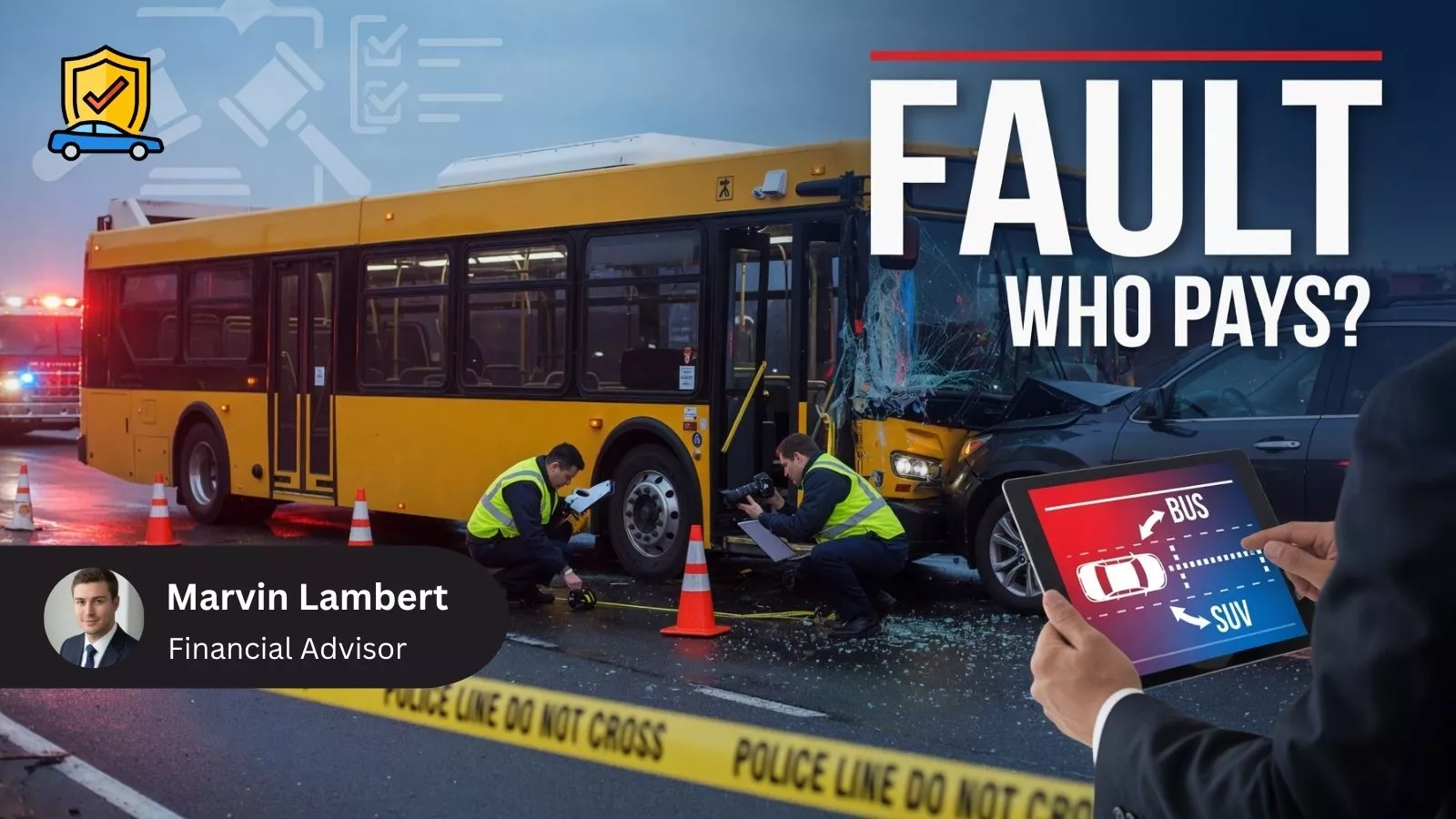
A bus crash can leave everyone with the same urgent question: who caused it? Insurance companies look for an answer quickly, but the process often involves more than one driver, more than one policy, and far more evidence than a standard car crash.
A city bus, school bus, charter bus, shuttle, tour bus, or rideshare-style passenger van may involve a private company, a public agency, a school district, a maintenance contractor, another driver, or a parts manufacturer. That makes bus crash fault determination more complicated than many people expect.
If you got hurt in a bus collision, you do not have to solve the fault question alone. You only need to protect the evidence, avoid common insurance mistakes, and get help before the paper trail disappears.
Why bus crashes create complicated insurance claims
Insurance companies do not simply ask, “Which driver made the mistake?” They usually ask several questions at once:
- Did the bus driver act safely?
- Did another driver contribute to the crash?
- Did poor bus maintenance play a role?
- Did the bus company follow hiring, training, and supervision rules?
- Did road design, weather, lighting, or traffic control affect what happened?
- Did a mechanical failure cause or worsen the collision?
- Did passengers suffer injuries because of unsafe seating, sudden braking, overcrowding, or lack of proper safety procedures?
A bus carries multiple passengers, so one crash can create many claims. Each insurance company may try to reduce its own responsibility. One insurer may blame another driver. Another may point to the bus company. A public transit agency may claim that a passenger waited too long to file notice. These disputes can delay payment and create confusion for injured people who need answers.
What insurance adjusters review first
Most adjusters start with the basic crash file. They gather the police report, driver statements, insurance information, photographs, and any citations issued after the collision. Those items matter, but they rarely tell the full story.
A police report may include helpful details, such as:
- The crash location and time
- Weather and lighting conditions
- Vehicle positions
- Statements from drivers, passengers, or witnesses
- Diagrams of the collision
- Traffic violations or suspected contributing factors
- Whether anyone reported injuries at the scene
Still, an officer usually arrives after the crash. The officer may not see the impact happen. Insurance companies know this, so they treat the report as important evidence, not the final word.
The most common bus crash causes insurers investigate
Every crash has its own facts, but adjusters often look for familiar patterns. Common bus crash causes include:
- Distracted driving by the bus driver or another motorist
- Speeding or driving too fast for traffic conditions
- Unsafe lane changes
- Failure to yield at intersections
- Following too closely
- Driver fatigue
- Poor training or lack of route familiarity
- Sudden stops that throw passengers forward
- Poorly maintained brakes, tires, lights, or steering systems
- Blind-spot collisions with pedestrians, cyclists, or smaller vehicles
- Dangerous pickup or drop-off practices
- Bad road design, missing signage, or broken traffic signals
- Impaired driving
- Aggressive driving by another vehicle near the bus
Insurance companies compare these possible causes with the physical evidence. For example, a bus company may claim that another car “cut off” the bus. Skid marks, video footage, vehicle damage, and traffic camera footage may support or weaken that claim.
Video often changes the fault picture
Buses frequently have more cameras than people realize. A transit bus may have interior cameras, forward-facing cameras, side cameras, and sometimes rear-facing cameras. Nearby businesses, homes, traffic systems, dashcams, and rideshare vehicles may also capture the crash or the moments before it.
This footage can show details that witness memories miss, including:
- Whether the bus driver looked down before impact
- How fast traffic moved before the crash
- Whether a passenger fell because of sudden braking
- Whether another vehicle ran a red light
- Whether the bus drifted from its lane
- Whether the driver used a turn signal
- Where passengers stood or sat before impact
Here is the catch: video does not always stay available for long. Some systems overwrite footage quickly. Nearby businesses may delete recordings on a routine schedule. If you wait weeks to ask for footage, the most helpful evidence may vanish.
A practical tip: if you can safely do so, write down nearby camera locations after the crash. Look for storefronts, gas stations, apartment buildings, schools, traffic cameras, and parked vehicles with dashcams. Even a camera that did not record the impact may show traffic flow, lighting, or the bus’s path before the crash.
Driver conduct and company responsibility
Insurance companies look closely at the bus driver’s decisions. They may review whether the driver followed traffic laws, adjusted for weather, kept a safe distance, and used proper caution around stops, intersections, pedestrians, and cyclists.
But the investigation should not stop with the driver. A bus company may share fault if it failed to hire, train, supervise, or schedule drivers safely. For example, an insurer may examine:
- Driver qualification records
- Training history
- Prior complaints or incidents
- Hours worked before the crash
- Route schedules and pressure to stay on time
- Drug and alcohol testing records, where applicable
- Company safety policies
- Dispatch communications
A driver may make the final mistake, but company pressure or poor safety practices can set the stage. Tight schedules, understaffing, skipped maintenance, or weak training can turn an avoidable risk into a serious crash.
Maintenance records can reveal hidden fault
Mechanical problems can play a major role in bus collisions. A bus requires consistent inspections and repairs because it carries heavy loads, travels long distances, and makes frequent stops. When an insurance company investigates, it may request maintenance documents to see whether the bus owner handled known issues properly.
Important records can include:
- Brake inspections
- Tire replacement history
- Steering and suspension repairs
- Light and signal maintenance
- Pre-trip and post-trip inspection reports
- Prior defect reports from drivers
- Work orders and repair invoices
- Maintenance schedules
One not-so-obvious issue: a repair record can matter even when the bus did not “break down.” For example, worn tires may increase stopping distance. Poorly adjusted brakes may make a rear-end crash worse. Broken interior handrails or unsafe flooring may increase passenger injuries during a hard stop.
How insurers use physical evidence from the scene
Crash scenes tell a story. Adjusters, investigators, and reconstruction professionals may study the location, vehicle damage, debris, tire marks, curb strikes, and final resting positions of the vehicles.
They may look at:
- Impact points on the bus and other vehicles
- Crush patterns and paint transfer
- Skid marks or yaw marks
- Damage to signs, poles, curbs, or guardrails
- Road grade, curves, and sightlines
- Traffic signal timing
- Posted speed limits
- Lane markings and bus stop placement
This evidence helps insurers test competing versions of events. If one driver says the bus sideswiped them, damage patterns may confirm or contradict that story. If the bus driver says they stopped gradually, passenger injuries and interior video may tell a different story.
Witnesses matter, but details fade fast
Passengers often provide the most useful observations in a bus crash. They may notice whether the driver braked suddenly, seemed distracted, argued with another motorist, drove aggressively, or ignored a hazard. Pedestrians, cyclists, nearby drivers, and business employees may also offer important accounts.
Read also: Car Insurance After an accident
Witness statements work best when someone gathers them early. After a few days, people forget exact times, traffic light colors, vehicle positions, and conversations. After a few weeks, they may move, change phone numbers, or lose interest in getting involved.
If you speak with witnesses after a crash, keep it simple. Ask for their name and contact information. Do not argue about fault at the scene. Do not coach anyone. Let them describe what they saw in their own words.
The role of comparative fault
Many bus crashes involve shared responsibility. An insurance company may decide that the bus driver caused part of the crash and another driver caused the rest. In some cases, an injured passenger may face an argument about their own conduct, such as whether they stood in an unsafe area, ignored instructions, or failed to hold a rail.
Rules about shared fault depend on the state. Some states reduce compensation based on a person’s percentage of fault. Others use stricter rules. Because local law matters, you should avoid assuming that an adjuster’s percentage breakdown reflects the real value of your claim.
Insurance companies sometimes use fault percentages as negotiation tools. A number in an adjuster’s letter does not automatically make it true.
Public buses and government claims add another layer
Claims involving public transit buses can move under special rules. A city, county, regional transit authority, or school district may require an injured person to file a formal notice within a shorter deadline than a typical injury claim. Missing that notice deadline can create serious problems.
This is one of the biggest differences between a bus crash and an ordinary car crash. You may still have medical appointments, repair issues, and time away from work, but the clock may run quickly in the background. If a public entity may own or operate the bus, get advice early.
What injured passengers should do after a bus crash
You can strengthen your position before the insurance companies finish their fault investigation. Start with these steps:
- Get medical care quickly. Some injuries feel minor at first and worsen later. A medical record also connects your symptoms to the crash.
- Report the crash and your injury. If you rode as a passenger, make sure someone documents that you were on the bus.
- Save your ticket, pass, app receipt, or route details. These details can help confirm the bus, driver, time, and route.
- Take photos if you can. Capture the bus number, license plate, damage, road conditions, traffic signs, and visible injuries.
- Write down what you remember. Include where you sat or stood, what the bus did before the crash, and what you heard people say afterward.
- Avoid recorded statements until you understand your rights. Insurance adjusters may ask questions that shape the fault narrative early.
- Do not post about the crash online. Insurers may look at public posts and twist casual comments.
- Keep damaged personal items. Broken glasses, a cracked phone, torn clothing, or damaged mobility aids can support the force and circumstances of the crash.
One practical detail many people miss: note the exact bus number, not just the route number. The route helps, but the vehicle number can lead to camera footage, maintenance records, and driver assignments.
Why insurers may dispute fault even when the crash seems obvious
People often assume a rear-end collision, red-light crash, or pedestrian impact creates a clear answer. Insurance companies still may dispute fault because they want to limit payouts, protect their insured, or shift responsibility to another party.
They may argue that:
- Another driver created a sudden emergency
- A passenger already had a pre-existing injury
- The bus driver could not avoid the collision
- The injured person exaggerated symptoms
- Poor weather caused the crash
- The police report got key details wrong
- A third-party contractor caused the problem
Some of these defenses may have merit. Others may rely on incomplete evidence. A strong investigation separates real defenses from blame-shifting.
How a legal team can help with bus crash fault determination
A legal team can move quickly to preserve evidence and deal with insurers before they lock in a one-sided version of events. That may include sending preservation letters, locating video, identifying all insurance policies, reviewing maintenance records, speaking with witnesses, and consulting crash reconstruction professionals when needed.
The goal is not to make the case more complicated. The goal is to make the facts harder to ignore.
A thorough bus crash investigation may uncover more than one responsible party, such as:
- The bus driver
- The bus company
- A public transit agency
- Another motorist
- A school district
- A charter company
- A maintenance contractor
- A vehicle or parts manufacturer
- A road contractor or government entity responsible for unsafe conditions
Identifying every responsible party matters because bus crash injuries can create major medical bills, lost income, long-term pain, and daily limitations. One insurance policy may not tell the whole story.
Talk with someone before the evidence disappears
Insurance companies start protecting their interests right away. You should have someone protecting yours, too. If you suffered injuries in a bus crash, contact a local injury attorney for a free consultation. Bring any photos, medical records, witness names, bus route details, claim numbers, and letters from insurers. Even if you feel unsure about fault, a focused review can help you understand what happened, which deadlines may apply, and what steps can protect your claim.

Marvin Lambert
Marvin LambertMarvin Lambert is a finance professional and financial advisor specializing in lending solutions, Car Insurance, personal finance, and consumer credit education. Through his writing, he helps readers understand practical money management strategies, borrowing decisions, and financial planning concepts in simple, actionable terms.